Wushan / Southern Song
吴山・南宋
The ridge that runs through Hangzhou's old city, from 吴山 to 八卦田, with the Southern Song imperial city on its middle hill. Two walks use it, both metro-bookended and mostly under canopy: a short citywalk through 城隍阁 and 鼓楼, and a longer traverse over 凤凰山 and 玉皇山 to the emperor's ceremonial field.
上城 is the old city, and its walking ground is a ridge rather than a shore. 吴山 rises directly behind 吴山广场 and continues south-east as 凤凰山 to 玉皇山, then drops to 八卦田. In 1138 the Southern Song made this line the backbone of their capital, and the palace, the imperial garden and the ceremonial field all sat on or below it; the ridge has been public ground ever since. Two routes use it: a 3 km citywalk at the 吴山 end, and an 8–10 km traverse that carries the same ridge over the other two hills and finishes at the field.
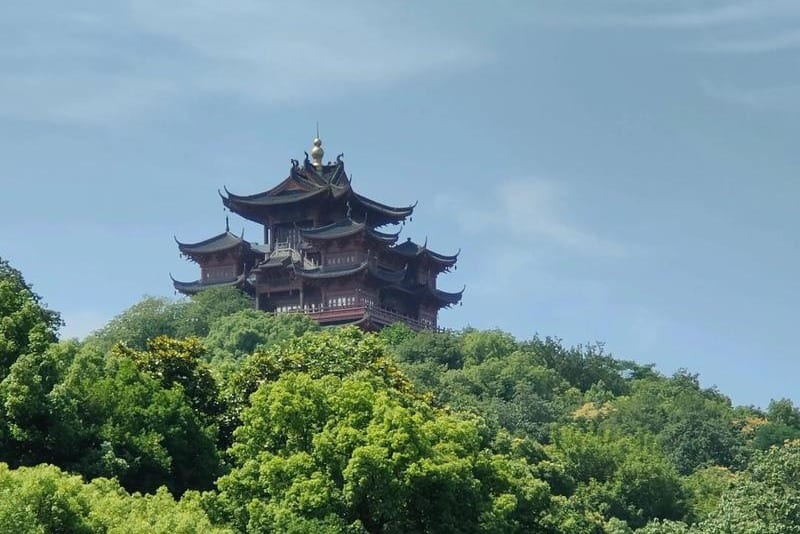
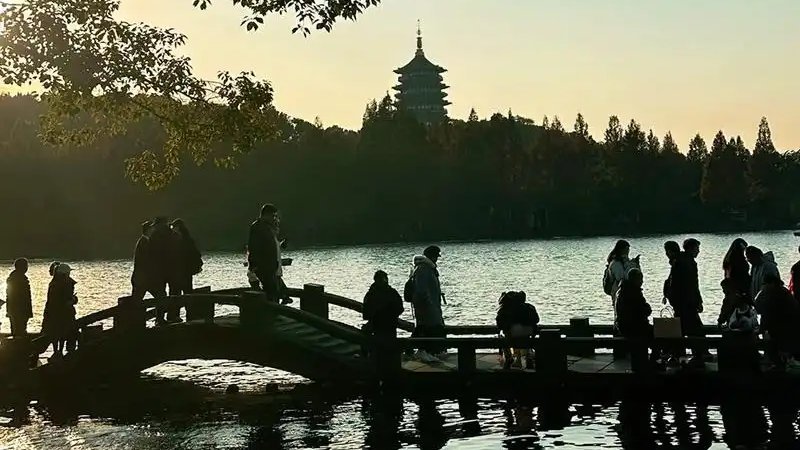
吴山 is the civic half. 城隍阁 stands on the summit, a 2000 reconstruction on the site of a Song temple, with a fourth-floor deck that takes in West Lake, the three causeways, 雷峰塔 and the 钱塘江 in one turn. The free 江湖汇观亭 at the ridge high point is the older view, and 积义亭 below it is a stone shelter all but swallowed by ivy. At the foot, 大马弄 market and the stone steps of 晓霞弄 lead up through camphor trees, and at the southern end 鼓楼 marks the old city gate, with 十五奎巷, 河坊街 and the 南宋御街 running north from it. This is the citywalk: market, hill, pavilion, old street, lunch.
凤凰山 is the imperial half. The Southern Song palace stood on this ridge from 1138 to 1276, and the walk crosses buried foundations, 圣果寺 ruins and 月岩, a natural rock arch that belonged to the imperial garden where the emperor watched the moon. 凤凰亭 is the high point, and beyond it the ridge runs over 将台山 and past the 5th-century Buddhist cliff carvings at 慈云岭. 玉皇山 comes next: 老玉皇宫 at its foot is known for an ancient wisteria, and 紫来洞, a limestone cave used for Taoist meditation, opens onto a terrace above the whole of 八卦田 with the 钱塘江 beyond. The cave stays cool in summer, which is why this is one of the few Hangzhou hill walks that still works in July.
八卦田 is the finish and the reason the ridge is worth reading as a capital. The four-hectare field is planted in eight wedges that rotate between rapeseed, rice, lotus and vegetables, and it was the emperor's own farm: he ploughed the first furrow each spring as a ritual. The perimeter path takes about 15 minutes. The two walks share the same ridge and the same metro start, but they are different days: 城隍阁 and 玉皇山 charge admission, the ridge pavilions and 八卦田 do not, and the short walk is a morning while the long one takes most of a day.