Qingshan Village
青山村
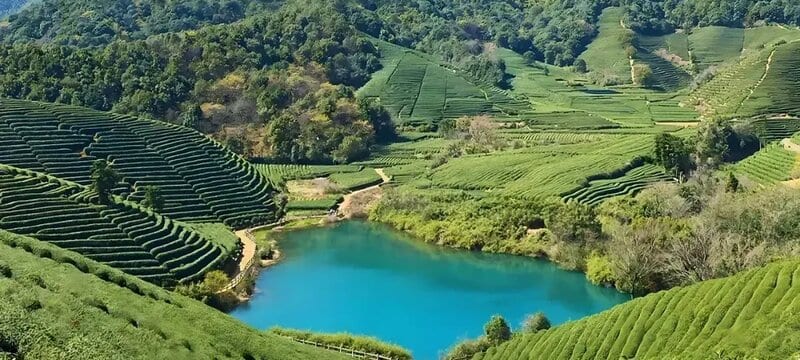
A hill village in Yuhang's Huanghu township that rebuilt itself around two projects: a public-interest trust protecting the reservoir that supplies drinking water to this part of the district, and a design archive that moved into the village theatre and stayed. Walks start at the library and run out to the dam; the 10.6 km classic loop climbs the ridge of that 32 km section twice, and the Little Bull line stays in the corridor below it.
Qingshan 青山村 sits in the low hills of 黄湖镇, in Yuhang District, about forty kilometres north-west of Hangzhou's centre, and it is one of the few rural places in the province whose reputation rests on work rather than on scenery. The first piece of work is water. In 2014 the Nature Conservancy began a catchment-protection programme at 龙坞水库, the small reservoir above the village, and the 善水基金 trust that followed put money directly with the farmers and fishers who use that catchment; the water moved from class III or IV to class I, which is the grade that can be treated into drinking supply without heroic measures, and the village's own designation as a 未来乡村实验区 dates from 2019. The second is craft. A design practice called PINWU founded 融设计图书馆 in 2015 inside the restored 东坞礼堂, the village hall, and built it into a working archive of traditional Chinese materials — bamboo, paper, wood joints, fibre, lacquer — with a residency programme attached. The two projects overlap in the village's trail series, 恋练青山, whose routes run out from the library and the Big Lawn into the catchment and up onto the 环浙步道, whose Huanghu Qingshan section measures 32 km with most of it on hill path. What this means for a visitor is that a short, easy walk can end at a drinking-water reservoir and start inside a design archive, and that the village has cafés, guesthouses and an exhibition schedule to fill the rest of a day. The catch is distance: two hours each way on public transport, a library that closes on Mondays, and buses that serve the village rather than the water.