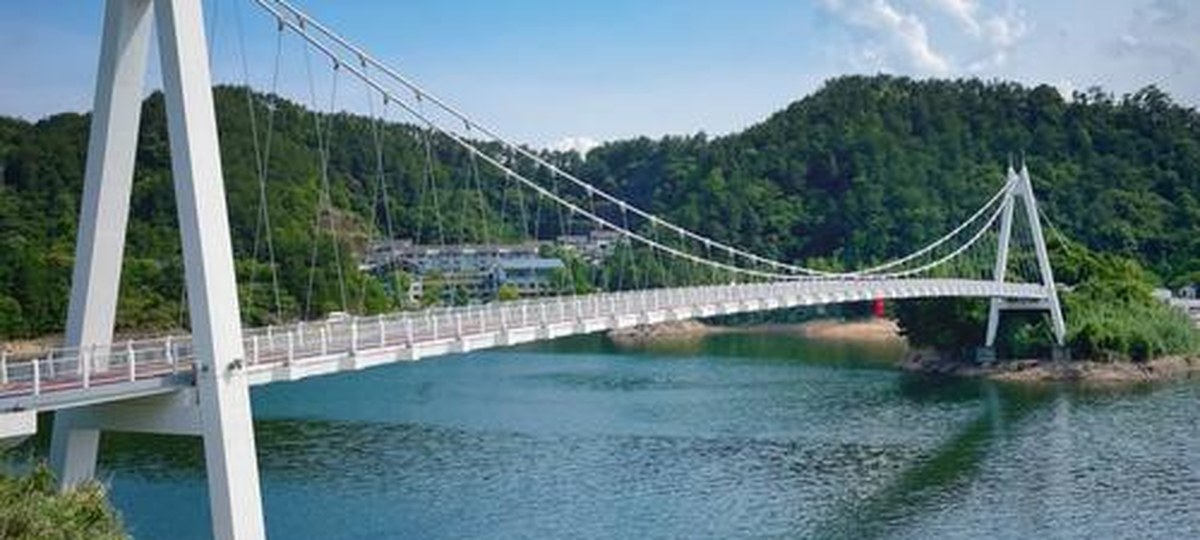
Qiandao Lake (Chun'an)
千岛湖(淳安)
A reservoir the size of a small county, 200 km of ring greenway around it, and one short lakeside segment on the Pailing Peninsula that can honestly be walked. The numbers the county publishes count four different things, and the walk is one of them.
Qiandao Lake 千岛湖 is the reservoir behind the 新安江 dam, filled in 1959, and the county that surrounds it, 淳安县, is the largest in Zhejiang by area and the least populated per square kilometre. What that produced is a shoreline of 1,078 islands and a ring of water that the county has spent fourteen years turning into a cycling destination. The numbers are worth separating before anything else. At the end of 2025 the county counted 688.66 km of greenway of all kinds, and inside that 200 km of classic ring-of-the-lake road greenway: a 150 km great loop around the central lake and a 50 km small loop around the north-eastern lake that opened in September 2024. A 2023 city tourism page gives 140 km for the 淳杨 and 千汾 lines, which is what the ring measured before the small loop existed. None of those four is a walk. The one segment a visitor without a bike can set out on is the 排岭半岛绿道 on the Pailing Peninsula in the county town, 7.3 km of lakeside greenway laid in 2012 as a test section, with station buildings, a car ferry at the western end and no ticket. The rest of the ring is a riding product, and the county says so: its own 2026 policy reply talks about bringing walking, camping and paddle-boarding into the greenway economy as something still being cultivated.
The other product in the county is not on the water. 千岛湖森林氧吧, a "forest oxygen bar" (the Chinese name for a wood you walk for its air), is a ticketed 3A scenic area on 淡竹王子山 in 千岛湖镇, 17.9 km from the county town as the crow flies and about thirty minutes by road. The 千岛湖国家森林公园 opened it in 2003 on 4,400 亩 of slope at 95.8 % canopy cover, and the scenic area's own introduction adds 300-plus plant species, the largest stand of wild 甜槠 in eastern China, and negative ions at 12,800 per cubic centimetre across the site rising to 58,000–62,000 at its highest point. Those are the scenic area's figures, repeated by encyclopaedia and booking pages rather than measured by anyone outside it, and no 淳安 or 杭州 page carries a primary statement of them.
Inside the gate the path follows a stream ravine past named features: 清风涧, 慕崖谷, the 百瀑竟欢 waterfall cluster, the 山涧绳桥 rope bridge, the 仙客栈道 ledge path and the 天梯 stair, and the scenic area suggests two to three hours. It publishes no length for that walk, and neither does anyone else. The 2 km, 2.5 km and 3 km figures in circulation come from commercial listings and travel posts that also misstate the canopy cover and the ion count, so this page prints no distance. What visitors do agree on is the shape of it: the first climb is hard, the steps are many, and the booking pages carry 遛娃好去处 and 不适合老人 on the same entry. The 悬崖魔毯 that skips the climb and the 七彩滑道 that skips the walk back are priced above the 60-yuan gate (55 online, 27 concession, bundles from 78 to 450 yuan). Four published sources give four opening-time windows, so confirm on the day; 淳安106 and 115 stop at the gate with no published headway; and the 景区's own line that its shuttle collects guests 全天随时 is a reason to take a taxi rather than a timetable.