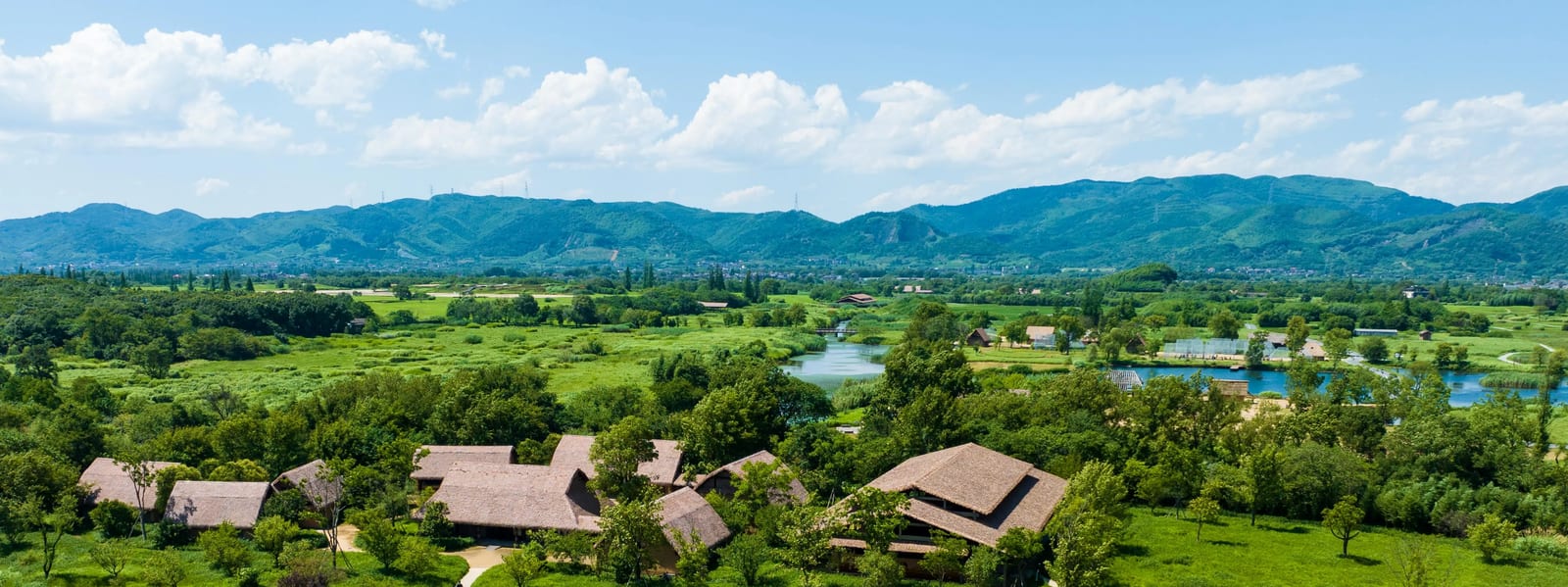
Liangzhu
良渚
The archaeological landscape northwest of Hangzhou where a 5,000-year-old walled city was found: a flat, wetland heritage walk across the UNESCO-listed Ancient City, the separate Liangzhu Museum 3.6 km east, the Yaoshan altar-and-burial site, and the 17.5 km discovery trail that threads the whole cluster together.
Liangzhu (良渚) is the archaeological district in Yuhang (余杭区), on the northwestern edge of Hangzhou, where a walled and moated city of the Liangzhu culture — dated roughly 3300–2300 BCE — was identified on the floodplain at Pingyao (瓶窑镇). Its inscription on the UNESCO World Heritage List on 6 July 2019 rests on the argument that this was the earliest state-level society yet found in the lower Yangtze: a rice-cultivating, jade-working people who raised rammed-earth platforms above the wetland, buried their rulers with carved jade, and engineered a water-management system at a scale that took organised labour to build. Because they built in earth and timber, almost nothing stands; what survives is topography, which is why the site rewards slow reading rather than sightseeing. The cluster is larger than the single walled city: the Liangzhu Museum (良渚博物院), 3.6 km east of the park, holds the richest collection of the objects; the Yaoshan Site Park (瑶山遗址公园) preserves a separate altar-and-burial site; and the Liangzhu Civilization Discovery Trail (良渚文明探索步道), about 17.5 km with 11 rest stations, runs east from the museum to Shili Canal at Pingyao and links them all. The area's headline walk is the flat nine-stop circuit through the Ancient City itself — an easy half-day on level ground, with the park shuttle as the pacing option and a mandatory timed reservation to plan around.