Gongshu Canal District
拱墅
Hangzhou's northern canal district, read as working water rather than scenery: the last urban reach of the Grand Canal, the granary and the mills that fed and clothed the city on its banks, and a walk that crosses three of the six World-Heritage sites the city registered. Flat, metro-bookended, and mostly free.
拱墅 is Hangzhou's northern district, and the ground a visitor is actually walking in it is the city's old granary-and-mill quarter on both banks of the canal's last urban reach. The scenic area frames itself as about 7.3 km of both banks, north to south; the water inside that frame is still load-borne, which is the one thing that makes a walk here different from a walk along the lake. Barges pass at any hour, the banks carry mooring and dredging gear, and the wharves were built for commuters before they were built for tourists.
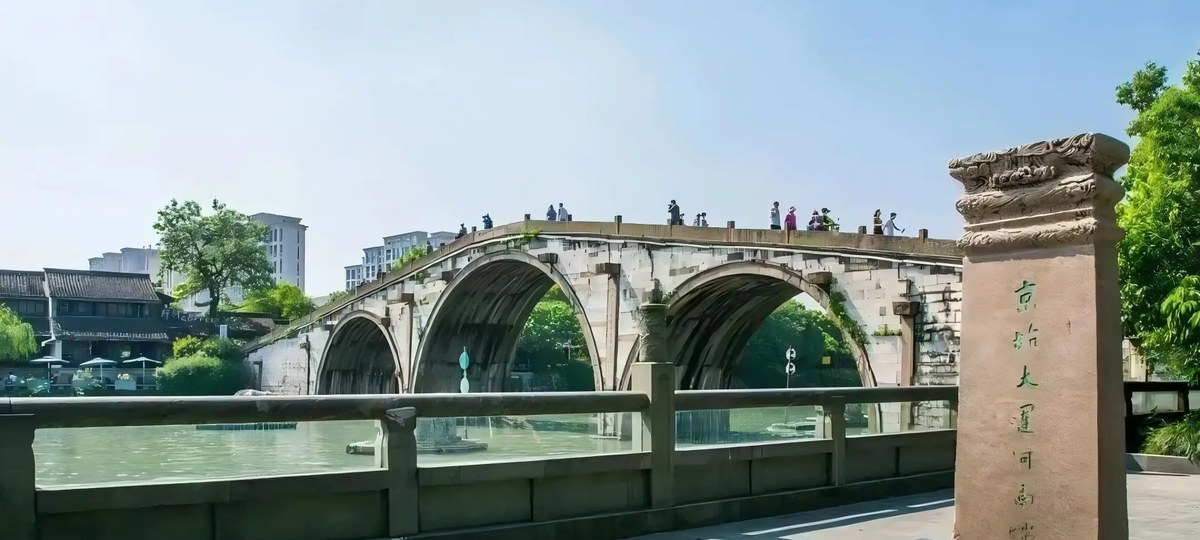
The heritage frame is worth stating precisely, because district signage tends to blur it. Hangzhou's nomination for the Grand Canal covers eleven components: six sites and five water sections. Three of the six sites stand in this district, and they sit close enough to walk in one line — 拱宸桥, the three-span stone bridge begun in 1631; 桥西历史文化街区, the historic street that is the city's only historic street on the list; and 富义仓, the 1880 grain depot with thirteen surviving storehouses. The ground they sit in is a designated historic-character sample district of roughly 342.8 hectares, bounded by 石祥路 to the north, 德胜路 to the south, 小河路 and 和睦新村 to the west and 金华路 to the east, and the district's own inventory for that area puts 30 protected sites at municipal level or above, more than twenty museums, 21 points of industrial heritage and 31 items of municipal-level or higher intangible heritage inside it. 小河直街 and 大兜路 are protected historic streets rather than listed components, and 香积寺 is a reconstructed temple with one provincial-level pagoda: worth seeing, not inscribed.
What makes the district walkable is a path system rather than a scenic trail. The 运道, the canal greenway, runs about 30.4 km along both banks between 石祥路 and the 钱塘江; the works that began in February 2022 cleared four places where it was cut — an oil depot among them — and reopened eighteen wharves so that boat and path connect. The district's scenic area talks of three historic streets and four parks, and of ten voted canal views, four of which are on the north-south line described above.
Without a car, the plan writes itself: metro line 5 in at the bridge end, line 3 out at the temple end, a 3-yuan water bus as the optional return, and lunch timed against a temple kitchen that stops serving around noon. The one real constraint is the museum calendar, because one institution here shuts on Mondays and the next on Tuesdays.